
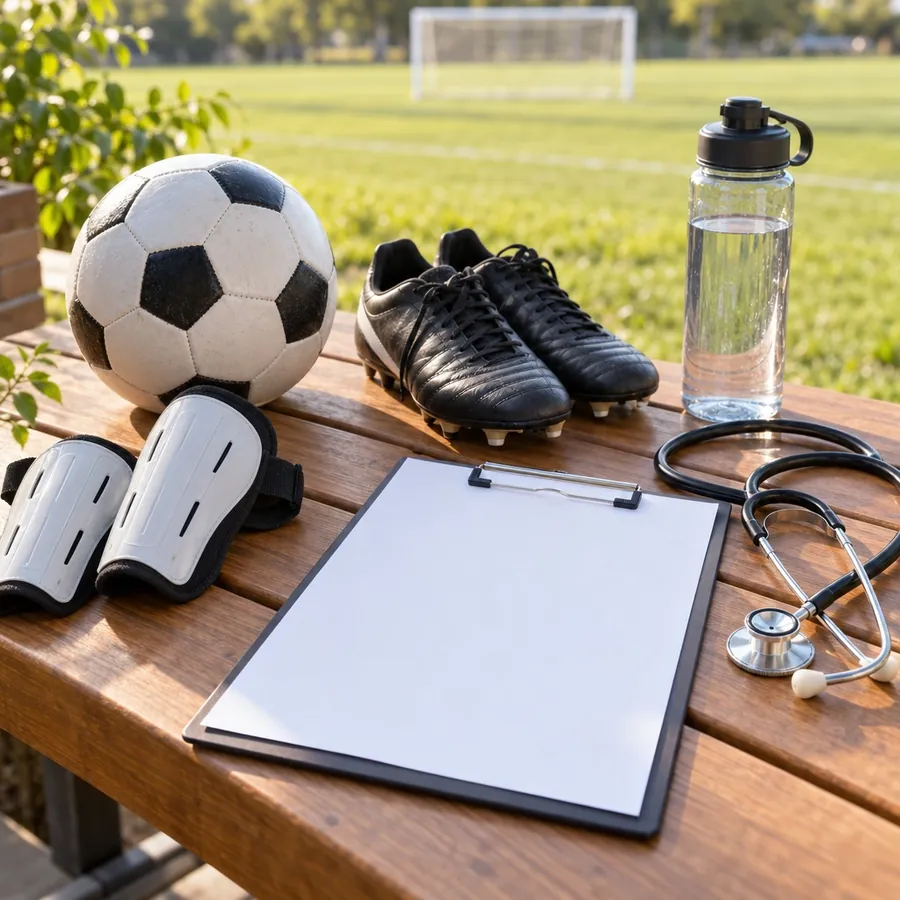
Which physical do you need?
The school, team, camp, college, nursing program or employer decides what the exam covers, and the provider completes their form. Find your group, then bring what it lists.
| You are | Bring |
|---|---|
| A high school athlete | The CIF history form, filled in and signed by the athlete and a parent |
| A younger student or a camper | The school or camp health form and the child's shot record |
| A college student | Your college's health form and your vaccine records |
| A nursing or health program student | The program's health packet, vaccine records and any past TB results |
| Starting a new job | The employer's exam form or authorization and the job description |
Everyone should also bring a photo ID, an insurance card if you have one, a list of medicines and supplements, and glasses or contacts for the vision check. Truck and bus drivers need the federal DOT physical instead, surgery patients need a pre-op physical, and green card applicants need the immigration medical exam.
More answers
What happens at a sports physical?
The California high school exam form spells out what the provider checks, and most sports physicals follow the same outline:
- Height, weight, blood pressure, pulse and vision, with a note on whether you wear glasses or contacts
- Eyes, ears, nose, throat and hearing
- The heart, listened to both standing and lying down, plus lungs, belly, skin and nerves
- Every joint area from the neck and back down to the feet
- Simple movement tests: squats on both legs and on one leg, and a step or box drop
Wear clothes you can move in. The form also reminds providers to ask privately about stress, mood, safety at home, vaping, alcohol, drugs and supplements. Honest answers matter, because the point is to find a problem before the season instead of during it.
How does the CIF physical form work?
The CIF posts its preparticipation physical evaluation (PPE) forms on its sports medicine page. There are three parts, and each has a different owner.
Filled in at home: the history form
The athlete completes and signs it before the visit, with a parent or guardian if under 18 (call ahead if a minor will come without a parent). It comes in English and Spanish and asks about:
- Medical conditions, surgeries, allergies, and every medicine and supplement
- Four short questions about worry and mood over the last two weeks
- Fainting, chest pain, a racing heartbeat or unusual breathlessness during exercise
- Relatives who died suddenly before age 35 or have an inherited heart condition
- Injuries, concussions, heat illness, eye problems, weight worries and, for girls, menstrual history
Answer the family heart questions at home, where you can check with relatives. The CIF's sudden cardiac arrest page asks parents and athletes to complete the health history together.
Filled in by the provider: the exam form
The provider records the findings and signs it. The history and exam pages belong in the athlete's medical file, not with the school. If a heart concern comes up, the form tells the clinician to consider an ECG, an echocardiogram or a cardiology referral, which may need to happen before clearance.
Turned in to the school: the medical eligibility form
This is the only page the school or team should receive. The provider marks one of five outcomes:
- Eligible for all sports without restriction
- Eligible for all sports, with recommendations for more evaluation or treatment
- Eligible for certain sports
- Not eligible until further evaluation
- Not eligible for any sports
It also has an emergency section for allergies, medicines and contacts, so have those ready. Separately, athletes and parents sign a sudden cardiac arrest information sheet each year with the sports packet; that sheet is for the family, not the provider. If an athlete collapses during play, call 911.
Some schools use their own version of these forms or an online clearance site. Use what your athletic office gives you, and ask how recent the exam must be. Save your spot for a sports or school physical.
What do California schools require for younger students?
California has two rules worth knowing before the school year:
- First grade health checkup. Within 90 days of starting first grade, families turn in a certificate showing a checkup done in the previous 18 months, so an exam during the kindergarten year fits. Parents may sign a waiver instead.
- Shot records. Schools check immunization records for every new student from TK through 12th grade and for every student moving up to 7th grade. Moving up to 7th grade takes one Tdap dose given on or after the 7th birthday. New students need the polio, DTaP, hepatitis B, MMR and chickenpox doses on the state list. The older rule requiring two chickenpox doses for 7th grade advancement expired June 30, 2025.
If a dose is missing, ask the front desk whether that vaccine is in stock before you come. Camp physicals work the same way: the camp sends a form, and you list every medicine your child will take there, inhalers and epinephrine included.
What does a college physical include?
Each college writes its own health form, so follow its checklist. Expect a standard exam plus a review of your vaccine history. Two CDC points help when you fill in the form:
- Measles: CDC accepts written vaccine records, a blood test showing immunity, lab-confirmed past measles, or birth before 1957 as evidence of immunity, and recommends the vaccine for college students without that evidence.
- Meningococcal: CDC recommends a MenACWY shot at age 11 to 12 and a booster at 16. If your form asks for dates, look for both.
Playing a college sport? The athletic department may have its own forms on top of the student health form. Save your spot for a college physical.
What do nursing school physicals usually require?
Requirements vary by program. Packets commonly combine a health form the provider signs, TB screening, and proof that you are protected against certain infections.
TB screening
CDC screens health care personnel for TB when they are hired, using a risk questionnaire, a symptom check, and either a TB blood test or a TB skin test. When the skin test is used for this first screening, CDC calls for two-step testing: if the first result is negative, a second skin test is placed 1 to 3 weeks later. With a reading 48 to 72 hours after each placement, a two-step skin test adds up to four trips, while the blood test needs one draw. A positive result usually leads to a chest x-ray, which this clinic takes on site.
The clinic offers both test types; call to confirm availability that day and the price, or see the flu shot and TB test page.
Vaccines and titers
CDC says health care workers should be up to date on COVID-19, chickenpox, flu, hepatitis B, MMR, and Tdap or Td, plus meningococcal vaccine for some lab workers. Your program decides which it requires and whether it accepts vaccine dates, a titer (a blood test showing immunity), or either. Titers are lab work, so call to confirm the clinic can draw the ones on your list and how long results take.
Save your spot for a nursing school or job physical. The same option fits health care jobs that ask for this packet at hire.
What happens at a pre-employment physical?
The employer's form sets the scope. A work physical here starts with a medical history focused on what the job demands, followed by a hands-on exam. Depending on the job, the employer may also want lab tests, vaccines or a drug screen.
If the job involves lifting or climbing, bring the job description, and ask the employer whether it pays the clinic directly or reimburses you. Save your spot for a pre-employment physical and drug screen.
How much does a physical cost here?
This clinic does not post a price for sports, school, college, nursing or work physicals, and shots, TB tests or lab work on your form may be priced separately. Coverage for these exams depends on your plan, so check with your insurer. Paying yourself? Call (714) 400-2959 for the current price, and see how self-pay visits work.
Common questions
Can I get a sports physical at urgent care in Anaheim?
Where do I get the CIF physical form?
How long does a sports physical take?
Is a sports physical the same as a yearly checkup?
Why does my nursing program want two TB skin tests?
Can an employer require a physical before hiring me?
Sources
- CIF: Preparticipation Physical Evaluation forms (history, exam, medical eligibility)
- CIF: Sudden Cardiac Arrest in Student-Athletes
- California Department of Public Health: Immunization Requirements for K-12th Grade (IMM-231)
- California Department of Education: Immunization and Health Checkup
- CDC: Baseline Tuberculosis Screening and Testing for Health Care Personnel
- CDC: Clinical Testing Guidance for Tuberculosis, Tuberculin Skin Test
- CDC: What Vaccines Are Recommended for You (health care workers)
- CDC: Measles Vaccine Recommendations
- CDC: Meningococcal Vaccine Recommendations
- EEOC: Preemployment Disability-Related Questions and Medical Examinations
Updated October 29, 2026